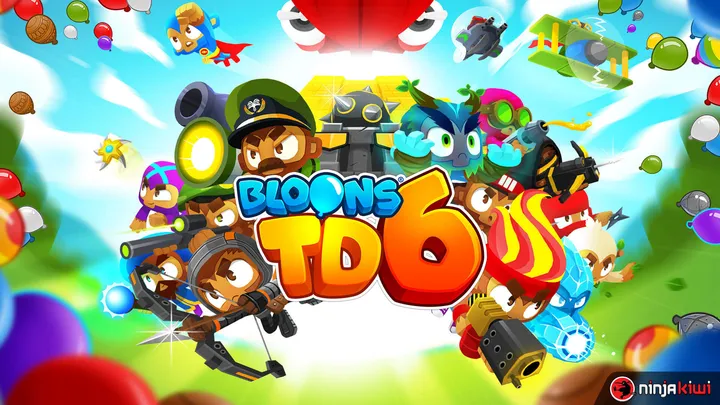






For the casual observer, Bloons TD 6 is a vibrant, fast-paced tower defense game about monkeys popping balloons. For the enthusiast, however, the standard 80 or 100 rounds of a typical match are merely a prologue. The true test of structural planning, mathematical scaling, and hardware endurance begins when the victory screen is bypassed and the game enters Freeplay Mode.
Freeplay is not just an endless continuation of previous rounds; it is a fundamental shift in the game's underlying physics and rules. As the round counter climbs past 100, standard strategies collapse under the weight of exponential health and speed scaling. To survive into the deep hundreds and thousands, a player must transition from tactical placement to a deep understanding of game architecture, algorithmic calculations, and the limits of the game engine itself. This exploration dissects the profound mechanical evolution of Freeplay, tracing how a simple defense game transforms into a complex simulation of mathematical optimization.
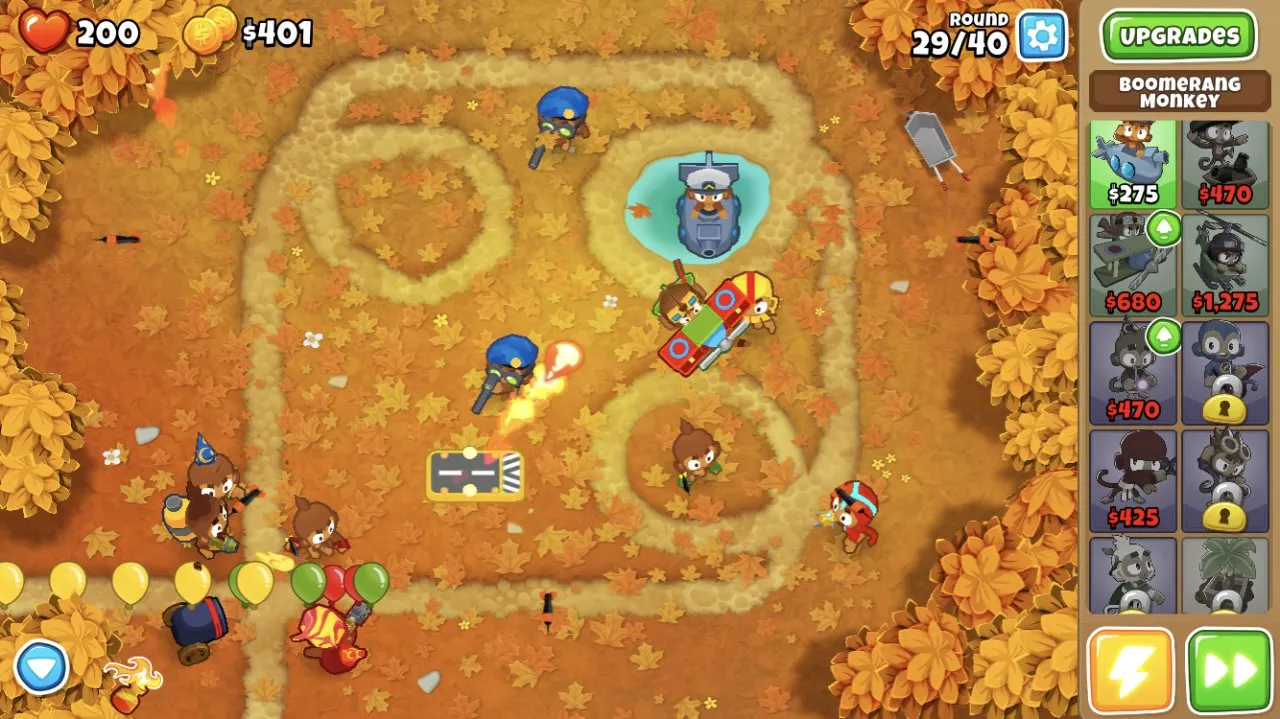
1. The Threshold of Round 81: The Structural Metamorphosis
[Rounds 1-80] --> [Round 81: The Great Shift] --> [Rounds 82+]
Standard Bloons Super Ceramic HP Scaling RAM Ramp-up
Dense Rushes MOAB Health Expansion Lag Mitigation Begins
The transition into Freeplay does not actually begin at Round 100, but rather at Round 81. It is at this precise moment that Bloons TD 6 fundamentally rewires its spawning logic. Prior to Round 81, the game challenges players with density—massive rushes of Ceramics, Regrow rainbows, and tightly packed MOAB-class blimps.
Upon hitting Round 81, the game engine introduces the Super Ceramic mechanic. Standard Ceramic Bloons possess 10 health layers and split into two Rainbow Bloons, which further split into consecutive children, resulting in massive entity counts. Super Ceramics compress this entire structural hierarchy. A Super Ceramic has significantly higher base health (60 HP, which scales further with rounds), but it only spawns a single Rainbow Bloon, which in turn spawns only a single child down to the Red layer.
Mechanical Impact: This shift drastically reduces the total number of physical entities on screen, preventing the game engine from crashing due to sprite overload, while simultaneously increasing the single-target damage threshold required to pierce through defensive lines.
This structural metamorphosis fundamentally alters tower viability. Towers that rely on high pierce and low damage per hit—such as the Ring of Fire or Ultra-Juggernaut—suddenly become obsolete. Conversely, towers that deal high single-target damage or percentage-based damage instantly skyrocket in utility. The game abandons its identity as a crowd-control simulator and becomes an aggressive check on raw, unrelenting DPS.
2. The Arithmetic of Eternity: Health and Speed Scaling Formulas
Survival in Freeplay requires a deep respect for the mathematical curves dictating Bloon attributes. The game does not scale linearly; instead, it utilizes distinct brackets of exponential growth designed to eventually overwhelm any static defense.
The Health Scaling Algorithm
Between Rounds 81 and 100, Bloon health increases by a fixed amount per round. However, once the game clears Round 124, the scaling factor shifts into an aggressive mathematical curve. The health multiplier $H(r)$ for a given round $r$ can be modeled through specific tiered multipliers:
- Rounds 1-80: $H(r) = 1.0$
- Rounds 81-100: Health increases by $2\%$ per round linearly.
- Rounds 101-124: Health increases by $5\%$ per round linearly.
- Rounds 125-150: Health increases by $20\%$ per round.
- Rounds 151-250: The multiplier advances to $50\%$ per round relative to the base curve.
- Rounds 251+: The compounding rate accelerates further, making Bloon health reach into the millions.
The Speed Scaling Phenomenon
Health is only one half of the endgame equation; speed scales concurrently, shortening the track length relative to the time towers have to attack.
Round Range Speed Multiplier Modifier
----------------------------------------
81 - 100 +2% per round
101 - 200 +5% per round
201 - 252 +2% per round
253+ Caps at maximum structural velocity thresholds
By the time a player reaches Round 300, a standard B.A.D. (Big Airship of Doom) moves at velocities that outpace the projectile speeds of many standard towers, demanding the use of absolute slowing mechanics, hitscan weaponry, and specialized global tracking systems.
3. Instakills and Percentage Damage: The Meta of Scaling Defiance
Because Bloon health scales infinitely, any tower that deals a fixed numerical value of damage will eventually become completely useless. If a tower deals 1,000 damage per hit, it is a god-tier asset on Round 90, but a drop in the bucket on Round 250 where a single B.A.D. possesses over a million hit points. To bypass this mathematical wall, the Freeplay metagame revolves around percentage-based damage and instant-kill mechanics.
[Infinite Bloon Health Scaling]
|
+-----------------+-----------------+
| |
[Percentage Damage] [Instant-Kill Utilities]
- Grand Saboteur (MOAB HP %) - BMA (Shrinks ZOMGs/BFBs)
- Sun Avatar (Knockback/Stall) - Navarch of the Seas (Hook-in)
- Legend of the Night (Passive) - XXXL Trap (Instant Consume)
The Bloon Master Alchemist (BMA) is a prime exemplar of scaling defiance. Its Shrinking Potion transforms any non-B.A.D. blimp, regardless of whether it has 2,000 HP or 2,000,000 HP, into a Red Bloon instantly. Similarly, the Ninja Monkey’s Grand Saboteur utilizes an activated ability that slices $25\%$ off the health pools of all incoming MOAB-class Bloons the moment they spawn.
The Limiters of Absolute Destruction
To prevent these mechanics from breaking the game entirely, the developers implemented explicit exceptions. The B.A.D. and the Boss Bloons are completely immune to instant-kill hooks, shrinking potions, and full stalls. Therefore, the architectural challenge of Freeplay splits into two distinct operational pipelines:
- The Blimp Vacuum: Utilizing instant-kills to erase ZOMGs, BFBs, and DDTs the microsecond they appear to keep the track clear.
- The Raw DPS Engine: Funneling the entire map’s physical damage potential exclusively into the massive, un-stoppable hulls of the B.A.D.s.
4. The Pantheon of Paragons: Apex Towers and Sub-System Synergy
Introduced to redefine the limits of the endgame, Paragons represent the absolute pinnacle of tower evolution. These units combine the mechanical traits of all three Tier 5 paths of a tower type into a singular, ultra-compressed entity. In Freeplay, Paragons are vital because they possess a hidden, hardcoded trait: they deal massive bonus damage exclusively to Boss Bloons and Elite MOAB-class entities.
The Paragon Power Formula
A Paragon's efficacy is tied to its Degree, ranging from 1 to 100. This Degree is determined upon sacrifice via a complex calculated system factoring in:
- Total cash spent on sacrificed monkeys.
- Total population (pop count) accumulated by the sacrifices.
- Total upgrades purchased across the map.
- The number of specialized "Gerry's Fire" items or Paragon Power Totems utilized.
Deep Dive into Specific Paragon Mechanics
The Navarch of the Seas (Monkey Buccaneer Paragon) acts as the anchor of any late-game setup. Beyond its passive aircraft carriers spawning high-velocity planes, it features an active ability capable of hooking in two B.A.D. blimps per round, completely ignoring their HP scaling.
Meanwhile, the Ascended Shadow (Ninja Paragon) permanently applies a global Grand Saboteur slow to all incoming blimps and distributes flash bombs that permanently stun everything below a B.A.D., serving as a vital mitigation layer against structural leaks.
5. The Vengeful True Sun God: The Sun Temple Sacrifice Matrix
If Paragons are the pillars of Freeplay, the Vengeful True Sun God (VTSG) is the foundation upon which the entire defensive ecosystem is constructed. Activating the VTSG is the most complex micro-macro puzzle within the game, requiring strict adherence to sacrifice thresholds across four distinct monkey categories: Primary, Military, Magic, and Support.
[Sacrifice Phase 1: Tier 4 Temple]
Must absorb $50k from 3 of 4 categories
|
[Sacrifice Phase 2: Tier 5 Temple]
Must absorb $50k from ALL 4 categories
+
Outside radius: Place "The Anti-Bloon" & "Legend of the Night"
=
[VENGEFUL TRUE SUN GOD TRANSFORMATION]
The Architectural Blueprint of Sacrificing
To maximize a VTSG, the player must first understand the limitations of the Tier 4 Temple. The Tier 4 Temple can only accept benefits from three of the four categories; sacrificing a fourth during the first stage is a waste of capital assets. The Tier 5 upgrade, however, requires sacrifices from all four categories, alongside the placement of the other two Tier 5 Super Monkeys (The Anti-Bloon and Legend of the Night) outside the Temple's radius.
The Support Category Conundrum
The Support sacrifice is the most mathematically influential choice in a Freeplay run. A maxed Support Temple provides a massive, global buff to all towers within its immense radius, granting:
- $+4$ pierce to all attacks.
- $+20\%$ attack speed.
- A massive $20\%$ discount on all local tower upgrades.
- A permanent $+10,000$ cash generation per round.
Crucially, in Freeplay, players will often construct a "Support-Skipped" VTSG and supplement it with separate, pure Support Temples down the line, ensuring that the primary damage-dealing deity maximizes its offensive damage output without sacrificing raw magical firepower.
6. The Synergy Web: Overclocking, Permanent Brews, and Homunculi Buffs
In Bloons TD 6 Freeplay, a lone tower is inherently inefficient. True optimization requires stacking multiple layers of multiplicative buffs onto your primary damage vectors. This concept transforms a few select Tier 5 towers into hyper-velocity death machines capable of processing millions of calculations per second.
Multiplicative vs. Additive Speed Stacking
The game calculates attack speed improvements through modifiers that compound upon the tower's base attack cooldown interval ($C_{\text{base}}$). The mathematically optimized stack includes:
$$\text{Final Cooldown} = C_{\text{base}} \times (\text{Ultraboost})^{-10} \times (\text{Homunculus Homeland})^{-1} \times (\text{Permabrew})^{-1}$$
The Essential Buffing Compendium
- Ultraboost (Engineer Monkey): Provides a stacking, permanent $+80\%$ attack speed bonus once ten stacks are applied via micro-management, which can then be boosted temporarily by an additional $+100\%$ with active ability targeting.
- Permanent Brew (Alchemist): Grants an uninterrupted buff providing $+1$ damage, $+3$ pierce, and a $17.6\%$ attack speed increase to any tower within its vicinity.
- Homeland Defense (Monkey Village): When activated, it doubles the attack speed and pierce of every single tower on the entire screen for 20 critical seconds.
By linking these components together, a Vengeful True Sun God's attack animation collapses into a continuous laser beam of plasma projectiles, scaling its raw damage output exponentially beyond its base capabilities.
7. The Subdiction of Space: Hitbox Manipulation and Placement Geography
As Freeplay scales into extreme rounds, space becomes the ultimate premium currency. The physical footprint of towers determines how many buffs can be packed together, how many temples can fit on a map without overlapping destructively, and how efficiently projectiles can intercept the shifting hitboxes of scaled blimps.
Choke Points and Line-of-Sight Mechanics
Different maps offer varying levels of geometric efficiency. On maps like Cubism or Logs, the track loops back on itself repeatedly. This allows towers with global or high-radius pierce, such as the VTSG or the Spirit of the Forest, to strike the same Bloon entity multiple times during its transit through the map.
[Track Entry Point] ---> (VTSG Radius - First Pass) ---> [Looping Point]
|
[Track Exit Point] <--- (VTSG Radius - Second Pass) <-------+
The Art of Miniaturization
To combat spatial limitations, advanced players utilize the Support Chinook (Heli Pilot) to lift and pixel-perfectly rearrange towers, alongside the Ice Monkey's Arctic Wind ability, which freezes water to create tiny operational platforms. Freezing water allows land towers to be placed in aquatic zones; if the Ice Monkey is later sold or sacrificed under highly specific parameters, the remaining towers can exist in highly compressed overlapping arrangements that defy standard grid placement logic, packing maximum DPS into minuscule zones.
8. The Sub-Visual Metagame: Projectile Desync and Hardware Bottlenecks
A highly fascinating aspect of Bloons TD 6 Freeplay is that the ultimate threat to a long-term run is often not the bloons themselves, but the player's real-world computer hardware. Freeplay is a notorious hardware burner, capable of dropping frames on top-tier gaming rigs down to single digits. This introduces a completely unlisted metagame: Lag Optimization.
The Calculation Crisis
Every single projectile on screen must calculate its positioning relative to the shifting hitboxes of hundreds of bloons. When a tower like the Sky Shredder fires hundreds of darts per second, each splitting or piercing through multiple layers, the CPU must compute millions of geometric intersections per frame. When the hardware cannot keep pace with these calculations, two phenomena occur:
- Frame Dropping: The visual display skips frames, rendering the pathing erratic.
- Projectile Desync: Calculations are dropped entirely, causing projectiles to visually pass right through Bloons without registering damage.
Structural Optimization for Computational Health
To reach rounds past 400, players must systematically eliminate high-lag towers, even if those towers deal decent damage. Towers that deploy complex tracking sub-projectiles, such as the Comanche Commander or Super Mines, are banned from ultra-late game layouts. Instead, the strategy shifts exclusively to hitscan or high-damage-low-projectile entities (like Paragons and VTSG) that deliver massive packet damage in single, clean computational sweeps, protecting the internal engine loop from melting down.
9. Defeat Mitigation: Subverting the Defeat Screen
No matter how optimized a defense is, the ramping speed of DDTs or the sheer bulk of reinforced B.A.D.s will eventually cause a leak. In standard gameplay, a single leaked blimp means instant death. In the Freeplay metagame, players construct explicit safety nets designed to exploit short-term invulnerability windows and rewind time.
The Three Pillars of Failure Isolation
- Legend of the Night (Super Monkey): Features a passive black hole ability that absorbs absolutely all leaking bloons for 7.5 seconds if they breach the exit line, granting complete immortality. This ability has a long internal cooldown, requiring the player to closely monitor its activation state.
- Pre-Emptive Strike (Submarine): Automatically fires a tracking missile at every single MOAB-class object the microsecond it enters the screen, instantly obliterating DDTs before they can even register on the primary defense's line of sight.
- Spike Storm / Perma-Spike (Spike Factory): Functions as a physical barrier at the very end of the track, acting as a clean-up reservoir to catch ultra-fast, damaged remnants that slip through the primary Paragon kill zones.
[Main Kill Zone] ---> [Perma-Spike Reservoir] ---> [Legend of the Night Black Hole]
(Paragons/VTSG) (Catches Fast Leaks) (Final 7.5s Immortality Node)
By layering these systems at the absolute terminus of the track, players create an architectural buffer zone. This allows them to run the simulation at high speed while maintaining a reaction window wide enough to manually activate global abilities or rearrange assets via micro-management if a systemic collapse begins.
10. The Ultimate Philosophy of the Endless Round: Deterministic Chaos
When all elements—the math, the Paragons, the spatial manipulation, and the hardware optimization—are aligned, Freeplay transitions from an active strategic strategy game into a mesmerizing, deterministic simulation. At this point, the game enters a state of chaotic equilibrium where human interaction becomes less about placement and more about systemic maintenance.
[System Maintenance Loop]
|
(Active Ability Cycles)
|
(Paragon Power Adjustments)
|
(Hardware Load Profiling)
|
[Repeat for Infinite Scaling]
At its deepest core, Freeplay strips away the casual aesthetic of Bloons TD 6 to reveal the raw, mathematical engine underneath. It challenges players to fight a war against compounding percentages, structural optimization limits, and the constraints of code execution. It is an exploration of optimization where victory is not defined by winning, but by pushing the boundaries of an inescapable, beautiful digital collapse just one round further.
This analytical exploration of Bloons TD 6 Freeplay details how the scaling formulas, Super Ceramic mechanics, Paragon systems, and engine optimization constraints convert a simple tower defense title into an endless mathematical simulation.